I recently jumped on board with an AI photo editing trend that I saw circulating in a Facebook group for photographers. Like many others, I was curious to see what all the excitement was about, so I uploaded one of my own images and gave it a try.
The results?
Absolutely gorgeous.
The artwork was stunning, creative, and looked like something straight out of a storybook. Yet every brushstroke, texture, and artistic interpretation was created entirely by artificial intelligence. It was fascinating to see just how far this technology has come.
There's no denying it—AI has quickly become part of our everyday lives.
Whether it's helping us write emails, plan vacations, summarize meetings, answer questions, create artwork, or organize our schedules, artificial intelligence has found its way into nearly every profession. Photography is no exception.
As photographers, it's easy to have mixed feelings about AI. Some embrace it wholeheartedly, while others want nothing to do with it. Personally, I think the truth lies somewhere in the middle.
Like any tool, AI can be incredibly helpful when used responsibly.
Where AI Can Be a Photographer's Best Assistant
Running a photography business means wearing a lot more hats than simply taking pictures. We're marketers, customer service representatives, editors, accountants, social media managers, web designers, bloggers, and business owners—all before we even pick up a camera.
This is where AI can truly shine.
Instead of replacing creativity, it can save valuable time on repetitive tasks.
Some great examples include:
- Brainstorming blog topics when inspiration runs dry.
- Writing or refining social media captions.
- Creating SEO-friendly website content.
- Generating newsletter ideas.
- Helping organize marketing calendars.
- Proofreading emails before sending them.
- Assisting with educational materials or client guides.
- Suggesting session ideas or shot lists.
- Helping create pricing guides or informational brochures.
These are all tasks that don't define your artistic style—they simply help you spend more time doing what you love: creating photographs.
AI can even be useful for creating artistic versions of existing images purely for fun or as optional keepsakes. Watercolor paintings, paper quilling, oil painting effects, mosaics, or other creative artwork can become unique products that complement your photography without replacing it.
Where AI Shouldn't Replace the Photographer
Photography has always been about more than pressing a shutter.
It's about noticing the little moments.
It's about calming nervous clients.
It's about making children laugh.
It's about knowing when the light is just right.
It's about anticipating emotion before it happens.
No algorithm can recreate genuine human connection.
While AI editing software continues to improve, I don't believe photographers should rely on it to completely edit their images from start to finish. Color correction, skin tones, artistic style, consistency, and attention to detail are all part of what makes each photographer unique.
Your editing style becomes your signature.
When AI takes over every part of the editing process, that signature begins to disappear.
Clients don't hire photographers simply because we own a camera.
They hire us because of our vision.
Because of our experience.
Because of the way we tell their story.
That human element simply can't be automated.
Can You Tell the Difference?
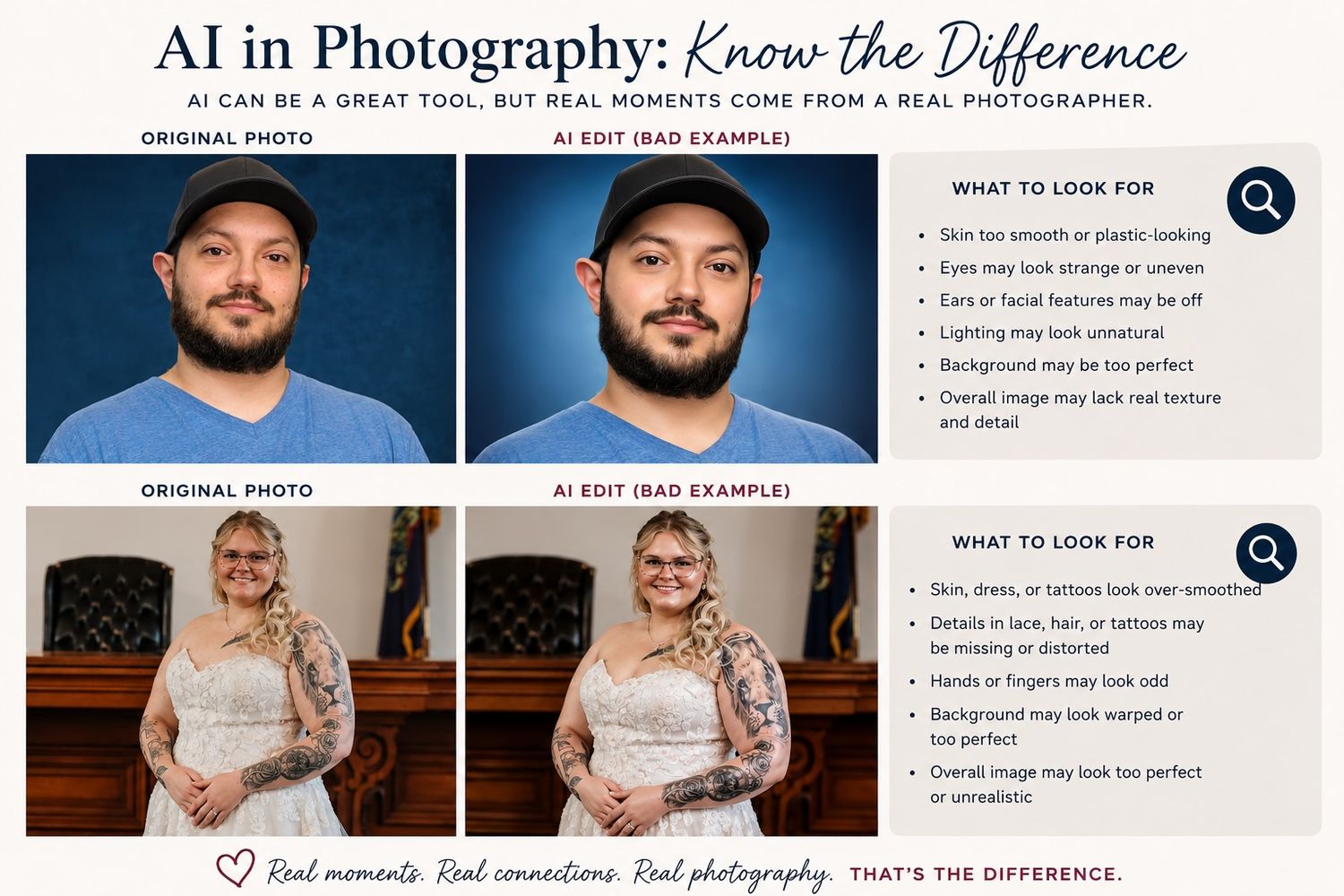
As AI-generated images become more realistic, the line between real and artificial continues to blur. However, there are often subtle clues that reveal an image wasn't captured by a camera.
Some common signs include:
- Skin that appears overly smooth or almost plastic.
- Fingers, hands, or teeth that look distorted.
- Hair that blends unnaturally into the background.
- Lighting that doesn't make physical sense.
- Eyes that lack natural depth or catchlights.
- Background details that seem warped or inconsistent.
- Clothing, jewelry, or objects that don't quite look right.
- Faces that appear almost perfect—but somehow feel lifeless.
Ironically, one of the biggest giveaways is perfection itself.
Real photographs contain tiny imperfections.
A stray hair.
A genuine laugh.
Wrinkled clothing.
Wind-blown leaves.
A child looking away for just a second.
Those imperfections often become the moments we treasure most.
A Help… and a Hindrance
AI is one of the most exciting technological advances our industry has ever seen.
It has the potential to save photographers countless hours, improve workflow, spark creativity, and help small business owners accomplish tasks they may not have had time to do before.
At the same time, it also creates challenges.
As AI-generated portraits become more common, consumers may begin questioning what's real. Expectations can become unrealistic when people compare themselves to images that never existed in the first place. There's also the risk of losing appreciation for the skill, patience, and experience that goes into creating an authentic photograph.
Technology should support creativity—not replace it.
My Thoughts Moving Forward
After experimenting with AI myself, I can absolutely understand why so many photographers are excited about it. The creative possibilities are endless, and it's incredible to watch technology evolve so quickly.
But at the end of the day, AI is exactly what it should be—a tool.
Not a photographer.
It can help us write better blog posts, organize our businesses, brainstorm ideas, and even create beautiful artistic interpretations of our work.
What it can never replace is the feeling of watching a father wipe away a tear as he sees his daughter in her wedding dress for the first time.
It can't anticipate the split-second smile between siblings.
It can't comfort a nervous child during their first portrait session.
And it certainly can't build relationships with families who return year after year because they trust the person behind the camera.
Photography has always been about preserving real stories, real emotions, and real connections.
If AI helps us spend less time behind a computer and more time behind the camera creating those moments, then it has earned a place in our industry.
But no matter how advanced technology becomes, the heart behind the lens will always matter more than the software behind the screen.
📸❤️🌻